
WHAT IS RPE: RATING OF PERCEIVED EXERTION
Listen to PODCAST here on Spotify or at above link
AUTOREGULATION
Autoregulation is a system that we will apply to our training as it allows you to select and adjust training intensity based on your performance each day – versus an assumption of what you should be able to do based on a previous day.
This is because we are complex human beings, with different amounts of stress on different days. Our strength may fluctuate daily, whether we want it to or not. And because of this, so does our performance.
This happens for many reasons:
Nutrition
Sleep
Stress
Work/Life balance
Relationships
Prior training or extracurricular activities
Mood and/or hormones
Training response
In addition, we ALL respond differently to the stresses applied to us. We adapt at different rates to the programmed workouts and can’t be held to a strict assumption for every session. Using autoregulation allows us to maintain a structure in our training plan but provide flexibility for our individual differences.
What we WILL assume is that if everything is feeling good, we can likely increase our weight each week to meet the same exertion level. And if everything is NOT feeling good, another week at the same weight (or even less) is probably exactly what we needed right then anyways, so it’s all still going according to plan.
RPE
Our method for autoregulation will be using RPE = “Rating of Perceived Exertion.” There are many methods and whether you know it or not, you probably already use it!
Simply saying to yourself “that was hard,” or “I don’t think I could do anymore of those” is the same concept… we’re just going to give it a numerical value.
The RPE scale goes from 1-10.
RPE 10 = MAX EFFORT, nothing left.
RPE 6 = the end of a warm-up
RPE 1 = Easy, general daily movement.
In our case, we won’t use anything under an RPE 6 as that is just your warm-up weight.
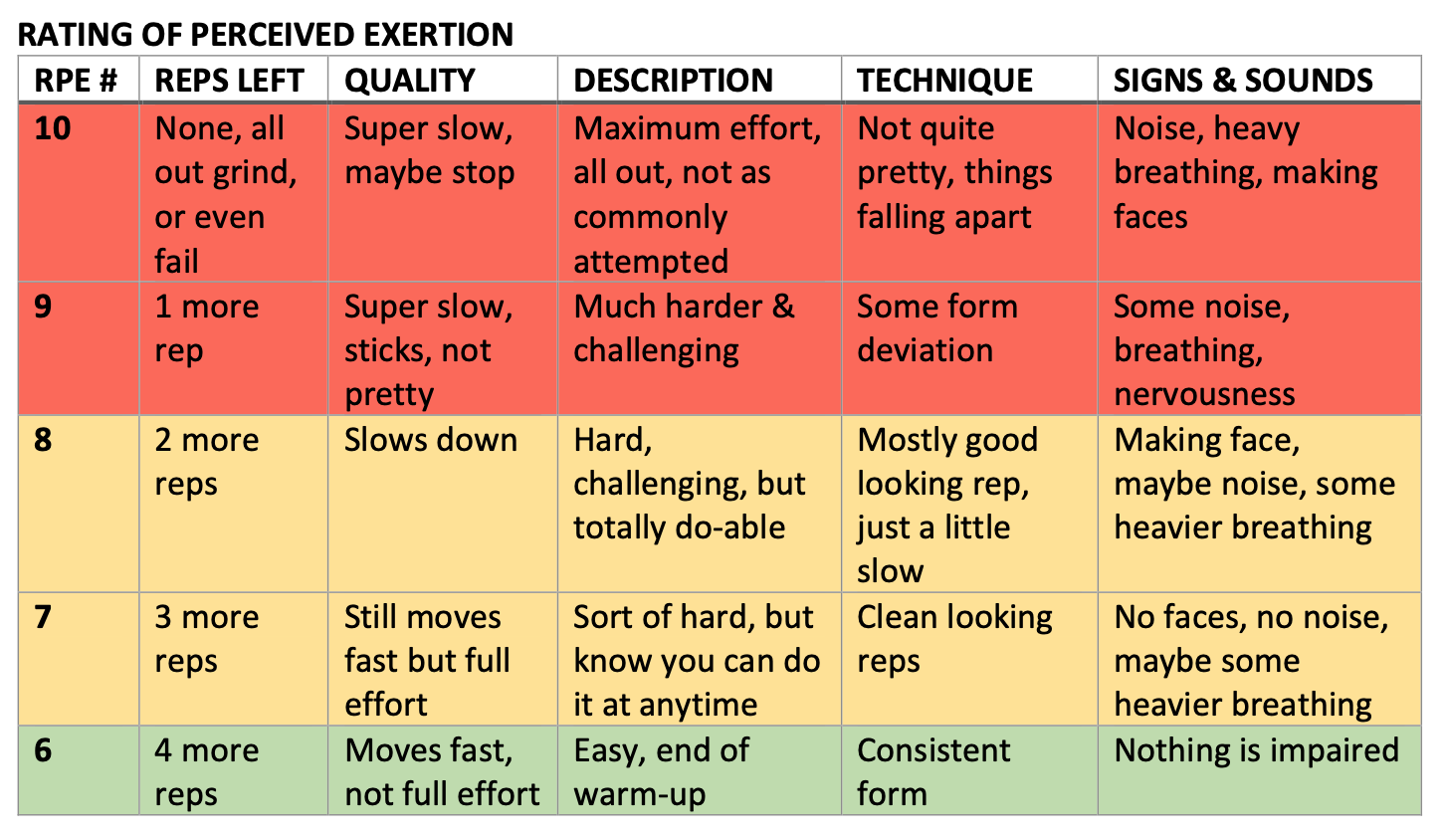
We may use RPE in your training one of two ways: as a description of what you did, or as a prescription of what you need to do.
For either option – use these 3 factors to help you define your intensity:
Bar speed: how fast the weight is moving throughout the lift
Technique: is it remaining effective
Feeling: how does it feel? Hard? Easy? This is the most subjective of factors.
As a coach, I can help you with the first 2 factors based on what I see. For #3, you have to communicate with me to help me fully understand how the intensity felt to you.
RPE AS DESCRIPTION:
In this case, I will ask you to describe how a certain set felt for the weight & number of reps prescribed. This is to help me gauge how “hard” something feels for you and for you to practice using the RPE system. I may even give you an expected RPE and you simply can tell me whether it matched or not.
RPE AS PRESCRIPTION:
This is how we will mostly use RPE. Here I would give you a prescription of a certain number of reps and sets at a specific RPE. Then it is up to you determine what weight that set will be.
For instance, I may write 4x2 @ RPE 8. This means you will do 2 work sets of 4 reps at the target intensity of RPE 8. Through your warm-up, you will work up to a set of 4 that fits the description in the chart above.
You will go into the workout with an expected weight for that intensity, but keep in mind it may change due to whatever other stressors in your life on that day. Plus, the weight may need to be adjusted each set in order to keep the sets at an RPE 8. Meaning, the sets may get harder as you go, so you are free to adjust the weight down to remain at the same intensity level.
If you overshoot – you’ll still count those sets towards your total work sets, just adjust the weight back down for the remaining sets.
RPE is not perfect.
It will take time to get it right and be confident in your decisions. And even then, you’ll often be uncertain of your accuracy. But research shows that most athletes that use RPE still see progress, even if they consistently overshoot or undershoot. You don’t have to be perfect to see progress.
This is where having a coach is helpful. You can pick a weight, do your work sets and I can help you understand how it went when you upload a video of those sets.
TIPS:
Do the set. Just focus on your technique and cues.
As soon as you’re done, give it an RPE number.
Don’t overthink it.
Keep doing it. Practice makes better.
There will be days where your RPE is not what you thought it would be. Due to several reasons. It happens. We’re human. Use your warm-ups as a guide and adjust the weight as necessary. It’s not that you got weaker. It’s simply that the stress needed today, to create an adaptation, is less than it has been on other days. Progress is still being made. This is why RPE exists. You are in control.
And then there are the days that feel great. This is where RPE can be great in that it allows you to push further when you can. Avoid overshooting but acknowledge that this is an opportunity, and you now know how to use it.
WARMING-UP:
1. Warm-up with the exact number of reps needed at your target intensity. Continue adding weight until you reach the RPE desired. So if the workset is a set of 4, do all warm-ups for sets of 4. This is preferable in the beginning when learning RPE.
2. Warm-up to your assumed target weight for a specific RPE, using the method of less reps + more weight each set. When you reach your target weight for the prescribed RPE, you’ll determine if your assumption was correct. Then you can adjust as necessary for following sets. This may be more suitable for top singles or as you understand RPE better.
MORE EXPLANATIONS:
RPE Part 1: https://www.youtube.com/watch?v=WXQaEq4_2lY
RPE Part 2: https://www.youtube.com/watch?v=2xEYSsfiWIE